
Key Points
This year, Democrats must press the Administration to advance a strategy that credibly deters Iran, clearly distinguishes between the Iranian regime and the Iranian people amid growing domestic unrest there, and delivers measurable progress implementing Phase 2 of the Gaza peace plan.
- Recent protests in Iran underscore both the regime’s vulnerability and the costs of its destabilizing policies, reinforcing the need to pair firm deterrence with explicit support for the Iranian people’s right to peaceful protest.
- At the same time, President Trump must demonstrate sustained progress and follow-through on the Gaza peace plan, particularly as it enters the more difficult and consequential Phase 2. This is vital to ensuring Israel’s security and supporting the long-term stabilization and reconstruction of Gaza.
- Much more diplomatic work will be needed to achieve these objectives.
Iran – Domestic Unrest
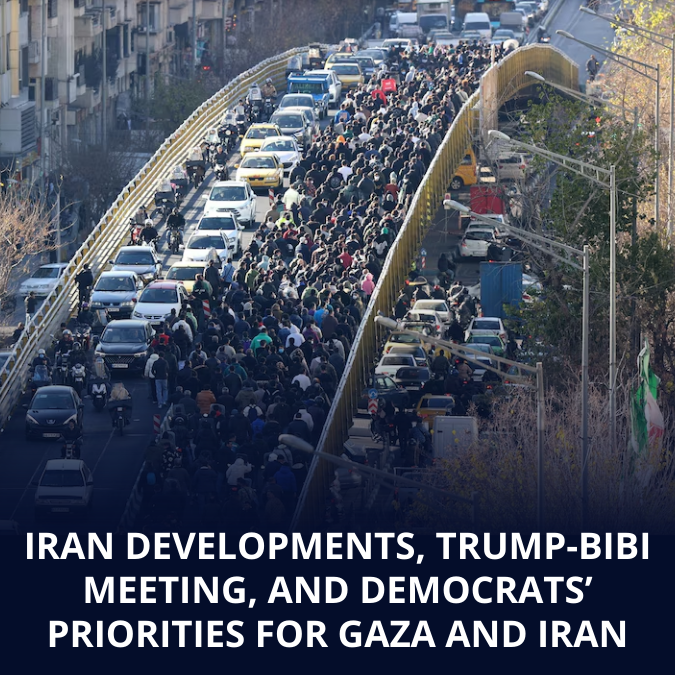
From the very end of 2025 through the beginning of 2026, Iran has seen renewed nationwide protests amid a deepening economic crisis in the country. The protests began among shopkeepers in Tehran after Iran’s currency hit a record low against the dollar, as many Iranians were already struggling to cope with rising prices for food and other basic goods. Demonstrations have since spread to other cities and sectors, reflecting broader public anger over the regime’s economic mismanagement, corruption, and prioritization of regional aggression over domestic economic relief. Together, these developments underscore the growing strain on the Iranian public and the regime’s increasing vulnerability at home.
- The protests are a reminder that the Iranian regime is not synonymous with the Iranian people. While Tehran pours resources into ballistic missiles, proxy wars, and nuclear escalation, ordinary Iranians are bearing the cost through inflation, shortages, and political repression.
- Democrats should speak clearly and consistently in support of the Iranian people’s right to peaceful protest, freedom of expression, and a government that serves their interests rather than exporting instability across the region.
- Democrats’ messaging should reaffirm U.S. support for the Iranian people’s aspirations for dignity, opportunity, and self-determination and highlight how the regime’s spending on missiles, nuclear weapons, and proxy terrorism comes at the direct expense of jobs, food security, and basic needs of Iranians.
- Supporting protesters is a moral and strategic imperative. A regime under internal pressure could be more constrained in its ability to escalate externally or launch new attacks against Israel.
Iran – Ballistic Missile and Nuclear Threats
- Iran remains the primary strategic threat to Israel and to regional stability. Israeli officials have warned that Iran is actively rebuilding its ballistic missile capabilities and its nuclear program following the 12-day war in June 2025. Iran also continues to support its terrorist proxies in the region, including Hamas and Hezbollah. U.S. leadership must remain firm in deterring Iran from efforts to rebuild its nuclear program or launching another ballistic missile attack against Israel.
- Iran must never be allowed to acquire a nuclear weapon. All diplomatic, economic, and military tools must remain on the table to prevent that outcome.
- The U.S. must continue to monitor and counter Iranian efforts to reconstitute its missile, drone, and nuclear capabilities.
- The U.S. must also provide credible deterrence. Iran must understand that renewed aggression will be met with decisive consequences.
- Ballistic missiles pose a strategic threat to Israel because they combine long range, high speed, and large payloads with limited warning time, making them difficult to intercept. As seen during Iran’s April 2024 aerial attack against Israel, Iran’s ability to launch missiles at scale and in coordination with other airborne threats stresses interception capabilities even with extensive U.S. and partner support, posing a significant threat to civilian populations, damaging homes, and causing mass displacement.
- If Iran were to launch another ballistic missile attack against Israel, the U.S. must help defend Israel.
- The U.S., in concert with international allies in the region, must maintain the force posture, regional presence, and missile-defense capabilities necessary to assist Israel in intercepting Iranian missiles and drones as it did in April and October 2024 and again in June of 2025. We must be prepared for all contingencies.
- This is essential to protect civilians in Israel and to preserve regional stability.
- The preferred path to prevent Iran from having a nuclear weapon has always been a diplomatic path. Read more about DMFI’s policy on the U.S. role in preventing a nuclear-armed Iran here.
Gaza
On December 29, 2025, President Trump and Prime Minister Netanyahu met at Mar-a-Lago to discuss implementation of Phase 2 of the Gaza peace plan, among other issues. For Democrats, this moment demands clarity and resolve: the ceasefire in Gaza must be sustained and Hamas must be disarmed.
While President Trump has touted success in Phase 1 of the plan, the achievement of those objectives are insufficient. We cannot rest on our laurels. Now is the time to lock in long-term strategic gains, and that requires an enormous amount of diplomatic work. Failure to do so would further threaten Israel’s security and perpetuate the humanitarian situation on the ground, diminishing the prospects for a sustainable path to peace and stability for Palestinians in Gaza.
- Phase 1 of the Gaza peace plan has largely been successful. All but one of the hostages have been released, the ceasefire is mostly holding, and substantial humanitarian aid continues to flow into Gaza.
- Phase 2 — where the most consequential security and governance steps must occur — appears to be stalling. While President Trump has expressed optimism about moving to Phase 2 soon, there is nothing that came out of the Mar-a-Lago meeting that indicates tangible progress has been made on this front.
- Phase 2 would require the disarmament of Hamas, the establishment of a transitional Palestinian technocratic governing authority, the deployment of an International Stabilization Force, the phased withdrawal of the IDF from Gaza, and the reconstruction of Gaza.
- Achieving these objectives will be extraordinarily difficult, but they are necessary to securing long-term peace, security, and stability for Israelis and Palestinians.
- We cannot allow the status quo to become permanent – or else Israel will be locked into a recurring cycle of violence as Hamas consolidates power in Gaza.
- The top priority must be the full and sustained disarmament of Hamas so that it can never again threaten Israel or suppress the rights, freedom, and security of the Palestinian people. The success of the entire Gaza peace plan, Israel’s security, and a brighter future for Palestinians rest on this central principle.
- There must be sustained international pressure on Hamas to comply with the 20-point peace plan, which was endorsed by the UN Security Council in November.
- To keep this process on track, the Trump Administration needs to demonstrate publicly that it has a plan to ensure the disarmament of Hamas.
- Several Gulf Arab states, including Saudi Arabia, the UAE, and Bahrain, have said publicly that they are reluctant to commit major financial support essential for Gaza’s post-war reconstruction unless Hamas is disarmed and excluded from governing roles in Gaza.
- Another top priority for Phase 2 will be to define a viable International Stabilization Force framework to address post-conflict security and governance in Gaza.
- Establishing a stabilization force that would eventually help demilitarize Gaza and support a civilian security transition is part of the peace plan. However, discussions regarding command and control and other key elements of the force are still being defined.
Conclusion
In summary, as we enter the new year, Democrats must press for credible deterrence of Iran while supporting the Iranian people, ensure tangible progress on Phase 2 of the Gaza peace plan, and maintain sustained diplomatic engagement to achieve these objectives.