
Recent press reports indicate that initial discussions between Israel and the United States on a new security Memorandum of Understanding have begun, an important and welcome step.
As these talks move forward, two priorities must guide U.S. policymakers:
- A strong MOU must continue the longstanding, bipartisan effort to ensure Israel has what it needs to defend itself in a rapidly evolving regional landscape.
- The United States must ensure Israel’s Qualitative Military Edge (QME) is fully maintained – an issue that has taken on heightened urgency following announcements on advanced U.S.-Saudi defense cooperation.
A Strong MOU
- Given the continued security threats facing Israel and the United States in the Middle East, it is imperative to have a strong MOU in place when the existing one expires in 2028 and to maintain the robust U.S.-Israel security partnership.
- MOUs have enabled Israel to protect civilians, carry out long-term defense planning, and serve as a pillar of U.S. strategic interests and national security policy in the Middle East.
- The next MOU should reflect an increase in aid levels and account for new and emerging security challenges.
- Israel has expended a large volume of munitions in the recent conflict, and upgrades to its aircraft fleet will likely be required.
- The next MOU should also address emerging threats, such as drones, tunnels, and cyber threats.
- Given that the U.S. military helped directly defend Israel from Iranian ballistic missile attacks three times in the past year and a half, there are a number of lessons learned about how to enhance Israel’s air defense and strengthen U.S.-Israel cooperation, as well as Israel’s military cooperation with Arab nations.
- The next MOU should support joint U.S.-Israel research and development, in addition to direct military assistance to Israel.
- Israel is a critical partner to the United States in the fields of defense tech and innovation.
- By dedicating funds to further collaboration, we can strengthen the U.S. defense industrial base and U.S. economic growth.
Background on the MOUs
- For decades, the U.S.-Israel security partnership has been governed by 10-year MOUs, which set funding levels and define the nature of the security relationship between Israel and the United States.
- The current MOU was signed in 2016 by the Obama Administration and will expire in 2028.
- It includes $33 billion in Foreign Military Financing (FMF) and $5 billion in missile defense assistance.
- Each year, funds are disbursed in equal increments ($3.3 billion in FMF per year and $500 million in missile defense per year).
- Even at the height of policy disputes with Israel at the time, the Obama Administration continued the bipartisan tradition of signing MOUs for long-term defense planning.
- There has been extraordinary bipartisan consensus in supporting and then implementing the current MOU.
- Since entering into force in FY2019, the current MOU has been implemented as planned, as annual appropriations have met the pledged levels.
- In 2020, Congress passed legislation, the U.S.-Israel Security Assistance Authorization Act, that authorizes the full $3.8 billion per year through 2028, effectively codifying support for the MOU’s funding levels.
- At times, annual funds have exceeded pledged MOU levels to address major wars.
- Supporting Israel’s security is in U.S. national security interests and helps save lives.
- Israel is a democracy in a region dominated by autocracies and terror groups. It shares America’s values — and its enemies.
- From Iran and its proxies, Israel faces real-world existential threats, which are simultaneously threats to America and global stability.
- Supporting Israel’s defense and deterrence capabilities helps prevent conflict and limits the chances that American troops will ever have to be involved in a wider regional war.
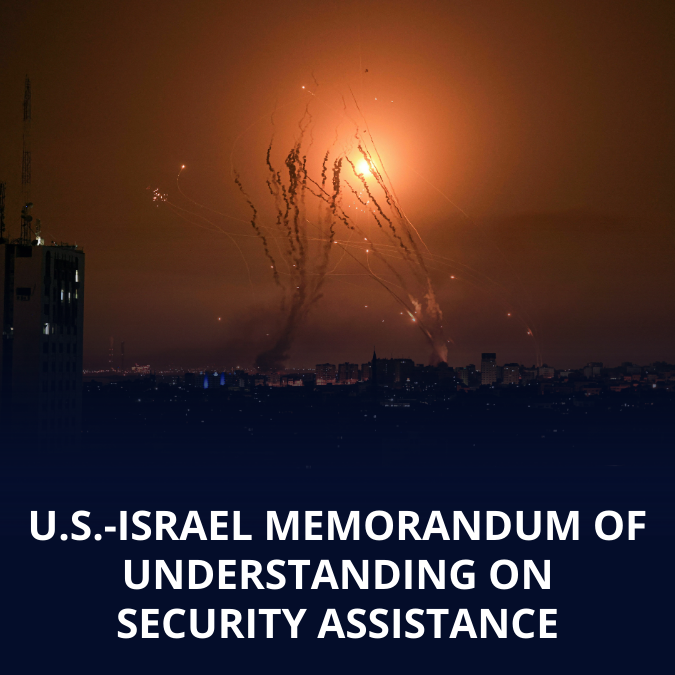
- The Iron Dome missile defense system, co-developed with U.S. support, has intercepted thousands of rockets launched indiscriminately at Israeli cities. These rockets target civilians — Jews and Arabs alike — including tens of thousands of American citizens. Iron Dome helps avoid broader escalation and war.
Maintaining QME
- The previous MOUs have allowed Israel to maintain its QME, which means it maintains superior military weapons and capabilities compared to its neighbors, something that is required by U.S. law.
- U.S. law states the U.S. must maintain Israel’s ability “to defeat any credible conventional military threat from any individual state or possible coalition of states or from non-state actors, while sustaining minimal damage and casualties.”
- Recent developments following the visit of Saudi Arabia’s Crown Prince to Washington underscore the importance of QME and call into question whether the Trump Administration is maintaining QME.
- Congress must provide strong oversight over whether the enhanced U.S.-Saudi defense cooperation, particularly discussions around F-35s or other advanced systems, as announced by the Trump Administration last month, unlawfully dilutes Israel’s military superiority.
- Any U.S.–Saudi defense upgrade must include measurable progress toward Saudi–Israeli normalization.
- A historic breakthrough between these two nations remains the single most powerful step the region can take toward long-term peace, security, and prosperity.
- While the rhetorical support by Saudi Arabia for the Abraham Accords is welcome, there have yet to be any firm commitments toward that goal.
- It is now incumbent on the Trump Administration to use our leverage with Saudi Arabia to make real progress toward normalization.