
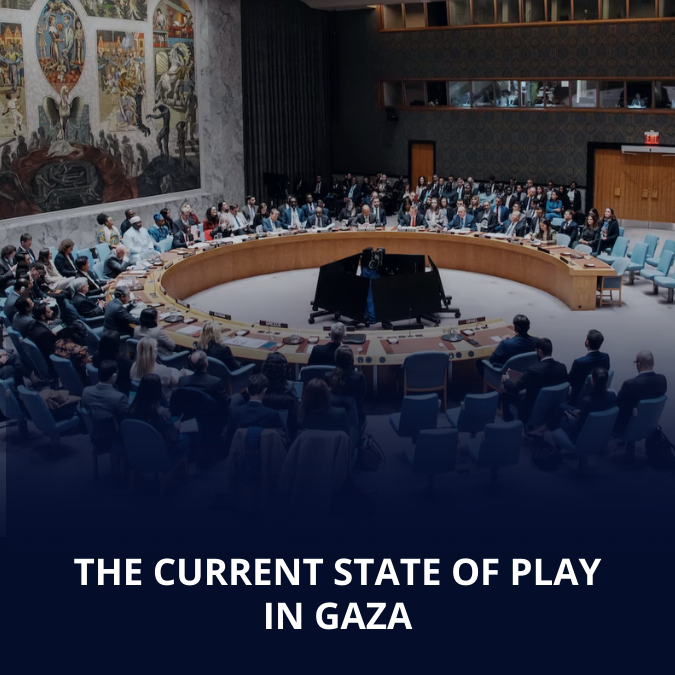
- UN Security Council Resolution is welcome step.
- Hamas continues to reject the peace plan; pressure must be brought on Hamas to agree to all 20 points of peace plan.
- Remaining bodies of three hostages must be returned.
- Aid has surged into Gaza and significantly alleviated the food crisis there.
Nearly six weeks since the hostage release and ceasefire deal was agreed to by Israel and Hamas, all the living hostages have been released, all but three of the remains of the deceased hostages have been returned, humanitarian aid has surged into Gaza, and the international community has formally endorsed the 20-point peace plan as part of a UN Security Council Resolution. These are all positive developments that must be built upon to ensure lasting security for Israel and stability in the region.
UN Security Council Resolution
- The UN Security Council’s adoption of the resolution on November 17, 2025, is a major diplomatic milestone that reflects broad international support for the core elements of the U.S. plan — ending the war, preventing Hamas from reconstituting, and stabilizing Gaza.
- Hamas has rejected the UN Security Council resolution and the broader 20-point peace plan – proving it is the obstacle toward peace and stability in the region.
- Hamas is now further isolated, as a lone voice opposing the measure.
- Following the announcement of the 20-point peace plan last month, Israel agreed to it.
- Hamas refused to agree to the totality of it; it only agreed to the provisions on a ceasefire and the release of hostages.
- The next phase requires sustained international pressure on Hamas to comply with the terms of the UN Security Council resolution.
- This momentum must now be translated into implementation. It is now time for the details to be filled in.
- The International Stabilization Force must be stood up and deployed.
- Hamas must be disarmed.
- A new transitional governing authority must begin operations in Gaza.
Hostages
- The remains of the remaining three hostages must be returned. Only then can we finally move forward from the horrific hostage crisis that Hamas created on October 7.
- The three remaining deceased hostages are two Israelis and one Thai national: Master Sgt. Ran Gvili, Dror Or, and Sudthisak Rinthalak.
- The international community must continue to exert pressure on Hamas to uphold its commitments made in Phase 1 of the deal, including to return the remains of all hostages.
Humanitarian Situation in Gaza
On the humanitarian situation in Gaza, DMFI hosted a briefing on November 18, 2025, with Yotam Polizer, Global CEO of IsraAID, Israel’s largest humanitarian aid organization, which has been instrumental in providing life-saving medical care, nutritional support and water desalination assistance to Gazans.
- The average number of trucks going into Gaza each day is currently 600.
- Polizer said that is “more than the average trucks that came in before October 7th.”
- They are not seeing evidence of widespread famine.
- Polizer said, “We have seen severe malnutrition in pockets of Gaza, but widespread famine or, of course, even worse accusations, as we heard, are not something that we witnessed.”
- There are additional needs in Gaza, including shelter and sanitation services, and Polizer said, there is a “huge effort” from the Israeli side and other humanitarian partners to address these concerns.
- Polizer said, “So, it’s not just about tent and shelter, which is obviously a big need — it’s also about how you prevent the spread of diseases and how you help people with their basic sanitation and hygiene. So, I would say people are asking, what is the biggest need right now in Gaza? One is shelter. Second is hygiene and sanitation, much more than food.”